Artifacts
Published Reports and Visuals
Central access point for antenna simulations, implementation summaries, timing baselines, and board-day artifact references.
Current FPGA implementation status
- Build 21 (v0.1.4-build21) is the current production baseline for the XC7A200T target. All timing constraints met: WNS +0.156 ns, WHS +0.064 ns, WPWS +0.361 ns.
- Utilization: 6,192 LUTs (4.6%), 9,064 FFs (3.4%), 16 BRAM (4.4%), 139 DSP48E1 (18.8%), 0.732 W total power.
- Key improvements over Build 20: FFT 4-cycle butterfly (20% throughput gain), barrel-shift twiddle index (-1 DSP48), Gap 2 GUI Settings (runtime chirp timing, stream control, status readback), E2E RTL fixes, Vivado DRC multiple-driver fix, MMCM LOCKED XDC false_path correction.
- Build 21 reports are available on the remote Vivado host at
~/PLFM_RADAR_work/vivado_project/reports_build21/.
Board-day artifact inventory
| Artifact |
Source path |
Day-0 use |
Status / note |
| Production-target XDC | 9_Firmware/9_2_FPGA/constraints/xc7a200t_fbg484.xdc | Constraint source of truth for the production FPGA target | Tracked and validated after Build 16 cleanup port |
| FPGA programming flow | 9_Firmware/9_2_FPGA/scripts/program_fpga.tcl | Programs the device and reports DONE / INIT_COMPLETE / probes presence | Primary operator-facing programming script |
| Debug probe insertion flow | 9_Firmware/9_2_FPGA/scripts/insert_ila_probes.tcl | Used when generating or refreshing debug-capable images | Keep matched with the selected debug bitstream |
| FPGA regression runner | 9_Firmware/9_2_FPGA/run_regression.sh | Pre-arrival regression evidence for the tracked FPGA baseline | 19 / 19 passing on the current tracked branch (includes E2E test) |
| MCU regression harness | 9_Firmware/9_1_Microcontroller/tests/Makefile | Pre-arrival firmware regression evidence before flashing hardware | 20 / 20 passing on the current tracked branch |
| Bring-up logging macros | 9_Firmware/9_1_Microcontroller/9_1_1_C_Cpp_Libraries/diag_log.h | Defines the main first-power-on log vocabulary used over USART3 | Observation-only instrumentation layer |
| Board-day worksheet | docs/board-day-worksheet.html | Record pass/fail, measurements, and blockers during first sessions | Use with this page and the bring-up plan |
| Bring-up execution plan | docs/bring-up.html | Operator checklist, abort criteria, observability targets, and open risks | Primary readiness document |
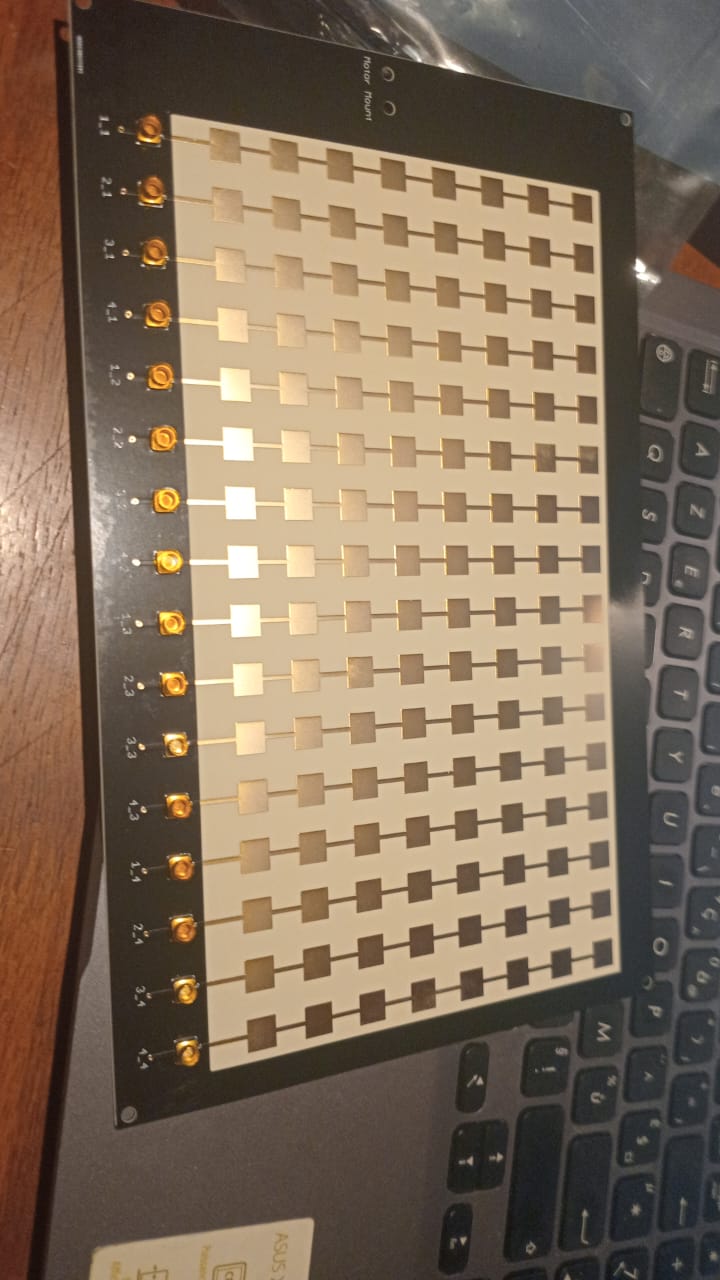
Antenna Simulation Report
Status: Mostly current (historical Phase-0 context)
File: AERIS_Antenna_Report.pdf
Notes: Valid for 10.5 GHz patch-element simulation and array projection context. Treat as element-level evidence, not full current hardware bring-up sign-off.
Open PDF
Download
Python Simulation Report
Status: Legacy (needs refresh)
File: AERIS_Simulation_Report.pdf
Notes: Contains older architecture assumptions (e.g., XC7A100T-centric narrative). Use as historical reference only until Simulation Report v2 is published.
Open PDF
Download
FPGA implementation analysis
Status: Current engineering baseline — Build 21 (v0.1.4-build21)
Build 21 is the current production baseline. Full timing, utilization, power, DRC, methodology, CDC, and route reports are available on the remote Vivado host. Setup slack is +0.156 ns (tighter than Build 20's +0.426 ns due to Gap 2 register map additions, but comfortable and better than the intermediate Gap 2 build at +0.078 ns). Hold slack improved to +0.064 ns. DSP count dropped from 140 to 139 via barrel-shift twiddle optimization.
Build 20 (v0.1.3-build20) retained as prior reference. Build 19 failed timing (WNS -0.011 ns) due to conflicting XDC generated clock, root-caused and fixed in Build 20.
Latest Simulation Report (Recommended)
Status: Current baseline (v2)
File: AERIS_Simulation_Report_v2.pdf
Aligned to the active project baseline: XC7A200T target, firmware regression closure, FPGA regression/timing gates, USB range-profile integration, and TE0712/TE0713 split-target flow.
Open PDF
Download
Report Currency Notice
- The current routed production-target baseline is Build 21 (v0.1.4-build21) with all timing constraints met. WNS +0.156 ns, WHS +0.064 ns, 139 DSP48E1, 0.732 W.
- Architectural gaps 2 (GUI Settings), 3 (Safety), 4 (USB Read Path), 5 (BRAM Reset), and 7 (MMCM) are closed. Gaps 1 (CFAR) and 6 (CDC-15) remain for post-bring-up.
- FPGA regression: 19/19 pass (includes new E2E integration test). MCU regression: 20/20 pass (15 bug-fix + 5 Gap-3 safety).
- FFT engine optimized and Vivado-verified in Build 21: 4-cycle butterfly (20% throughput gain) + barrel-shift twiddle index (freed 1 DSP48, 140 → 139).
- Detailed Build 21 engineering reports are on the remote Vivado host at
~/PLFM_RADAR_work/vivado_project/reports_build21/.
- The artifact inventory above is intended to stabilize day-0 execution even when detailed internal engineering reports stay outside the public docs site.
Antenna concept snapshot